
You Cheated. Now What?
How to Rebuild Trust After Cheating (and Fix What’s Actually Broken)
If you cheated and you feel sick when you wake up… you’re not alone.
Most men don’t just feel “guilty.” They feel panic, shame, emptiness, and an internal question that won’t shut up:
“Am I a bad person… or am I broken?”
This post is for the man who hit that line where:
“punishing yourself” stopped feeling like responsibility
and started feeling like self-destruction
Because here’s the truth: you don’t fix cheating with willpower. You fix the mechanism underneath it.
Prefer to watch instead of read?
Why men cheat (the part nobody wants to admit)
On the surface, cheating looks like lust, boredom, revenge, or a midlife crisis.
Underneath, it’s usually the same thing:
An internal pressure system that never learned how to release, so it leaks into secrecy, validation, impulsive dopamine hits, rage, and numbness… until it leaks into the one thing you swore you’d never do.
Translation: when your system gets flooded, your brain starts prioritizing relief over values.
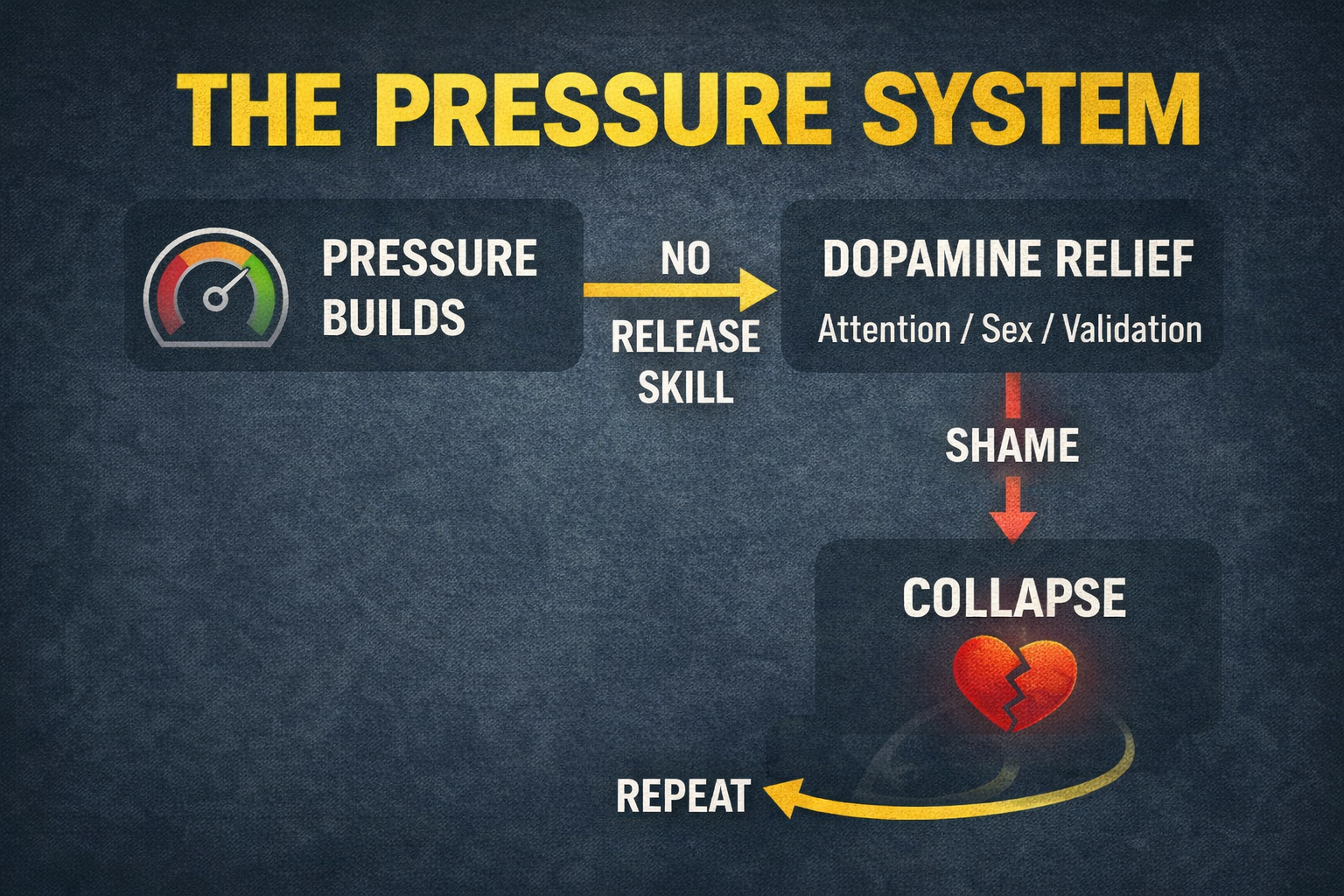
The two traps men fall into after cheating (and why both fail)
After cheating, most men default to one of two strategies:
1) Punishment
Replaying the movie every day. Agreeing with every hateful thought. Treating self-disgust like justice.
2) Performance
More work, more proving, more “I’ll become the perfect man now,” plus grand gestures to try to cover the stain.
Both make sense.
Neither heals the mechanism that produced the cheating.
Because the real mechanism is:
a flooded nervous system
an inner-child survival state
an attachment wound
and an identity collapse
Step 1: How to stop the shame spiral (so you don’t make it worse)
When shame hits, most guys either clamp down, explode, escape, or chase relief.
Here’s a micro-tool that brings your brain back online:
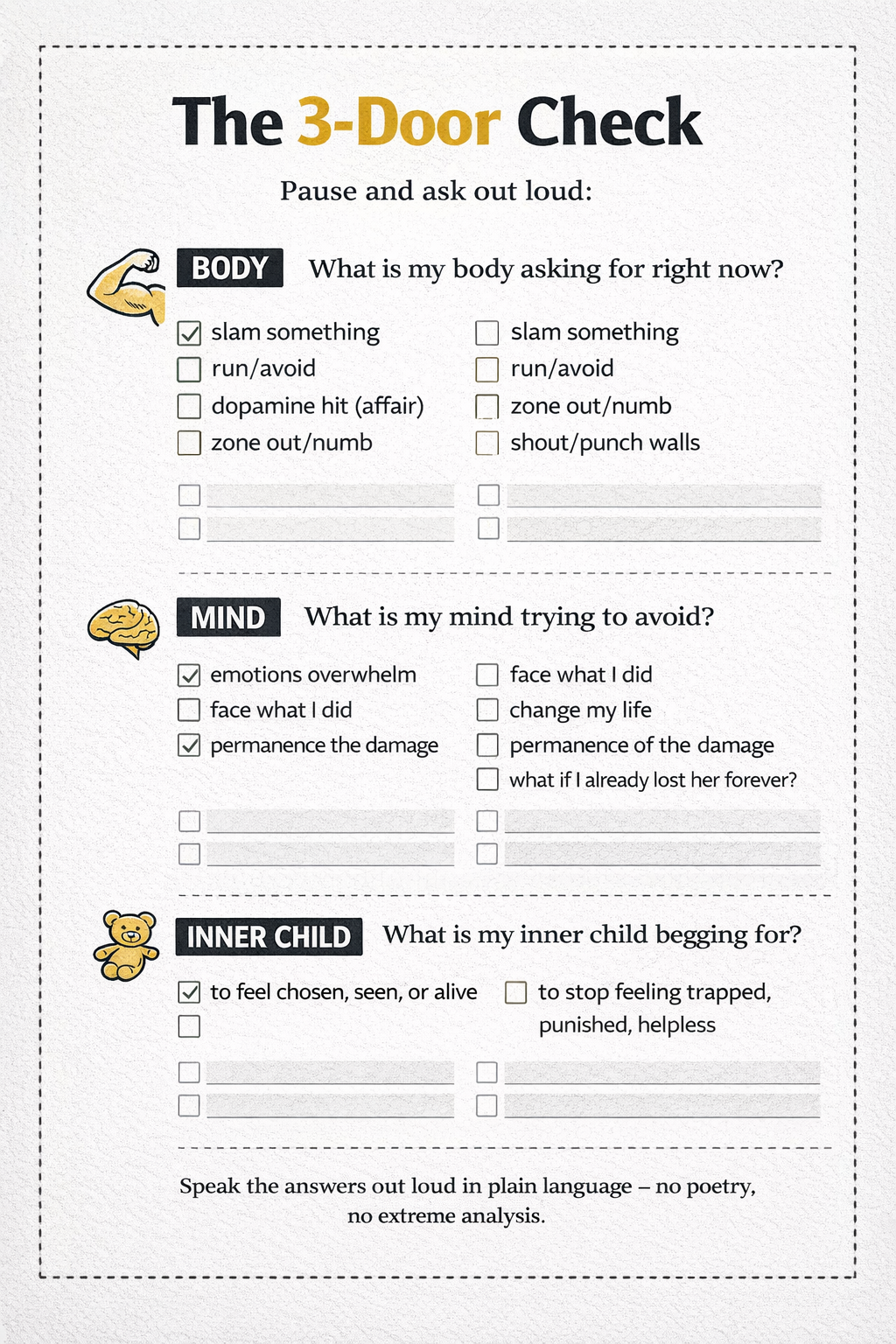
The “3-Door Check” (Nervous System Reset)
When you feel the surge, self-hatred, spiraling, compulsive texting, impulse, pause and ask three questions out loud:
What is my body asking for right now?
What is my mind trying to avoid?
What is my inner child begging for?
Use plain language. No poetry. No over-analysis.
This matters because naming the state helps your prefrontal cortex come back online, so you shift from reaction to response (real responsibility).
Step 2: The root cause of cheating (two common origin stories)
Men often arrive here through different wiring, but the pattern looks similar.
Origin Story A: Chaos
You learned control. You became the rock. You handled pressure alone.
Then adult stress hits, marriage tension, rejection, loneliness, and your system goes back to the old solution: control, escape, relief, power. Cheating becomes a fake form of regulation.
Origin Story B: Emotional Absence
Everything looked “stable,” but emotional truth was missing. No emotional language. No safe place for fear, grief, loneliness, desire.
You become publicly competent, privately starving. Unmet needs become appetite → appetite becomes impulse → impulse becomes a decision that can cost you your life as you know it.
Important: Understanding the root cause is not an excuse.
It’s a prevention plan.
Step 3: What to say after cheating (an accountability script that lowers chaos)
If you’re trying to rebuild trust after cheating, your words matter, but structure matters more.
When a conversation has 10 branches, everyone loses. Escalation comes from unpredictability.
Use this:
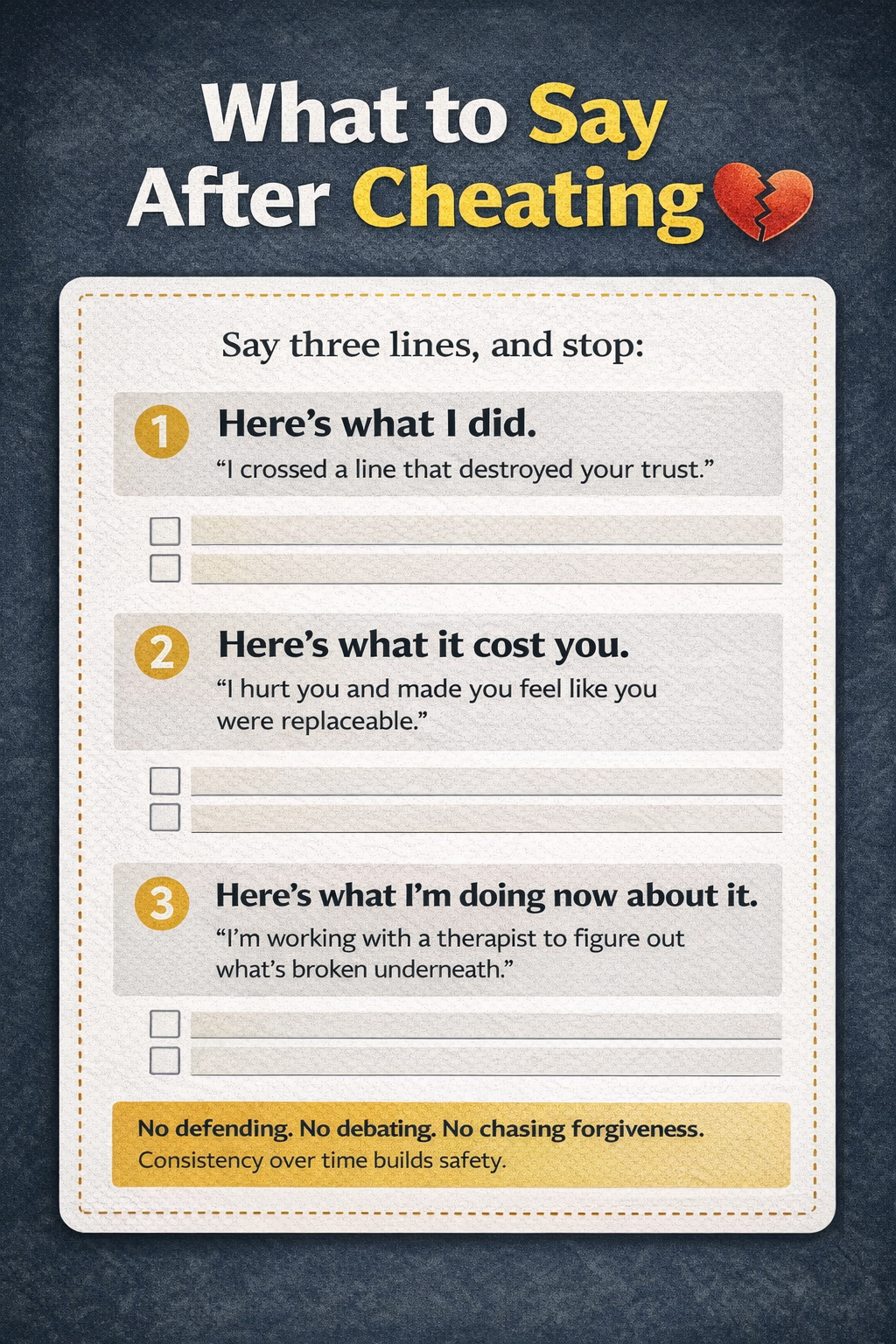
The 3-Sentence Container
Say three sentences… and stop.
Here’s what I did.
Here’s what it cost you.
Here’s what I’m doing now about it.
No defending. No debating. No chasing forgiveness.
This creates a boundary, reduces chaos, and begins rebuilding safety, because safety is consistency over time, not one perfect conversation.
Step 4: How to stop cheating patterns (meaning-making without excuses)
If you keep treating yourself like a monster, you stay stuck inside a label.
Here’s the prompt that turns this into change:
Meaning-Making Prompt
What was I trying to feel?
What was I trying to stop feeling?
Examples the transcript gives: chosen, powerful, alive… or trying to stop feeling neglected, invisible, like you ruined everything already.
Then the key:
You don’t use the answer to excuse what you did.
You use it to build a prevention plan that’s real, legitimate ways to feel what you were chasing, and capacity to hold what you were avoiding.
The stakes (why you can’t “just move on”)
If this continues, it usually goes two directions:
Explosive: rage, threats, compulsive texting, impulsive hookups, chaos, substance abuse, and the “I could burn my life down in one night” moment.
Slow-burn: functional but dead inside. Providing but numb. Sitting next to your kids feeling like a stranger. New relationships, same emptiness. And that constant drain: “Am I dangerous? Am I worth loving? Am I going to repeat this?”
If you’re having thoughts about ending your life
Treat that like an emergency. Reach out to someone in your real world today. In the U.S., you can call or text 988 for immediate support.
Want a clear plan that holds up under pressure?
If you want clarity, structure, and a real plan (not motivation hype), schedule time with me:
Work with me 1-on-1 → https://calendly.com/theobstacleremover
Can a relationship recover after cheating?
Yes, when the cheating is treated as a mechanism problem (state + attachment + identity), not just a “try harder” problem.
What should I say immediately after cheating?
Use the 3-Sentence Container: what I did, what it cost you, what I’m doing now about it. Then stop.
How do I stop cheating urges from coming back?
Start with state control (3-Door Check) and meaning-making (what you were trying to feel / stop feeling) so you can build a real prevention plan.